


Knowledge base
- 3 l, 5 l and 10 l PET bottles cover the needs of catering and HoReCa – a pallet holds between 600 and 800 l of oil; the format is selected according to consumption volume and the way the oil is dispensed.
- The 1000 l IBC container is dedicated to industrial plants with liquid-handling infrastructure and consumption exceeding several hundred litres per month.
- Standard and high-oleic sunflower oil (HOSO) are two technologically distinct products: the standard variety performs best in cold applications (dressings, sauces), the high-oleic variety in frying and snack production.
- The price of sunflower oil depends on the variety (standard/HO), packaging format, volume and certification – quotations are always individual.
- Rafsol Group as a manufacturer offers both varieties of sunflower oil across the full range of formats, with private label options and a full certification package.
Available sunflower oil packaging formats – overview
The choice of the right packaging format depends on the scale of monthly consumption, storage infrastructure and the way the oil is dispensed – in both catering and production settings.
| Format | Unit capacity | Units per pallet | Pallet capacity | Typical customer |
|---|---|---|---|---|
| PET bottle | 3 l | 216 units | 648 l | Catering, HoReCa |
| PET bottle | 5 l | 120 units | 600 l | Catering businesses, restaurants |
| PET bottle | 10 l | 72 units | 720 l | Large kitchens, small manufacturers |
| IBC container | 1,000 l | 1 unit | 1,000 l | Food industry |
| Tanker | most often 25,000 kg (approximately 22,500 l) | – | – | Large production plants |
Standard or high-oleic sunflower oil – which variety to choose?
Sunflower oil is available in two commercial varieties with materially different functional properties. Choosing the right variety is more important from a technological perspective than choosing the packaging format – a wrong choice at this stage can result in problems with the shelf life of the finished product or in an excessively short frying oil life.
Standard (linoleic) sunflower oil:
- Linoleic acid (omega-6) content: 50–70%
- Lower thermal stability, smoke point approximately 200–230°C
- Applications: dressings, marinades, salad sauces, oil blends, cold applications
- Lower unit cost than the high-oleic variety
High-oleic (HO) sunflower oil:
- Oleic acid (omega-9) content: 75–90%
- Markedly higher oxidative stability, smoke point 225–240°C
- Applications: deep-fat frying, production of crisps and snack products, an alternative to traditional frying fats
- Longer life under thermal load, lower TPM degradation figures
High-oleic sunflower oil – industrial applications
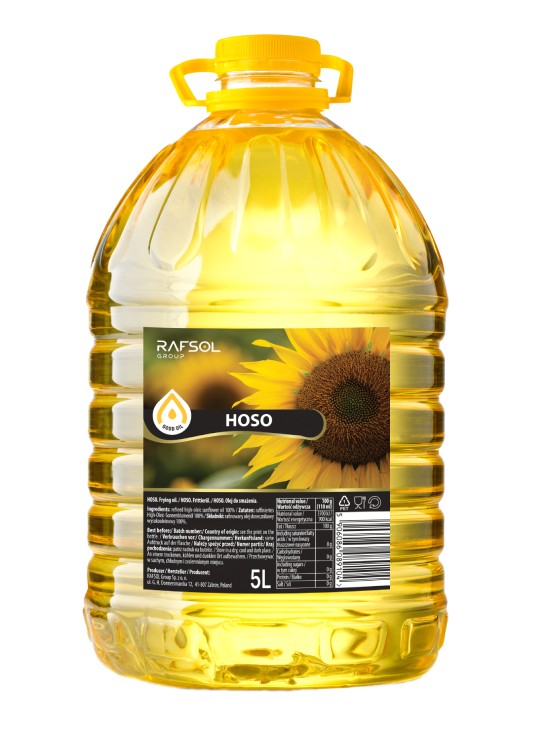
High-oleic sunflower oil is increasingly used as a raw material for the production of snacks, potato crisps, pellet snacks and extruded snack products. Its oxidative stability – comparable to that of speciality oils – combined with a neutral flavour profile makes it an attractive alternative to palm fats or rapeseed-based frying fats.
—
The detailed properties of both sunflower oil varieties and their effect on the parameters of the finished product are described in the article: Sunflower Oil – Properties
—
Sunflower oil 3 l – the PET bottle for small catering operations
Sunflower oil in the 3 l bottle is a format intended mainly for small catering operations and the HoReCa segment. A pallet holds 216 bottles with a total capacity of 648 l. The 3 l format works well wherever oil is dispensed directly by kitchen staff and product turnover is high – which limits the risk of parameters deteriorating during storage.
The 3 l bottle is available in both varieties – standard and high-oleic.The choice of variety should depend on the intended use: the standard variety is sufficient for salads and marinades, while the high-oleic variety is the choice for frying.
Sunflower oil 3 l – price and order conditions
The price of 3 l sunflower oil depends both on the variety selected (standard vs high-oleic) and on the order volume. The high-oleic version is more expensive due to the higher cost of the raw material and its significantly better thermal performance.
Order conditions and current pricing are available on submission of an enquiry.
Sunflower oil 5 l and 10 l – formats for catering and larger customers
Sunflower oil 5 l – a balance between convenience and cost efficiency
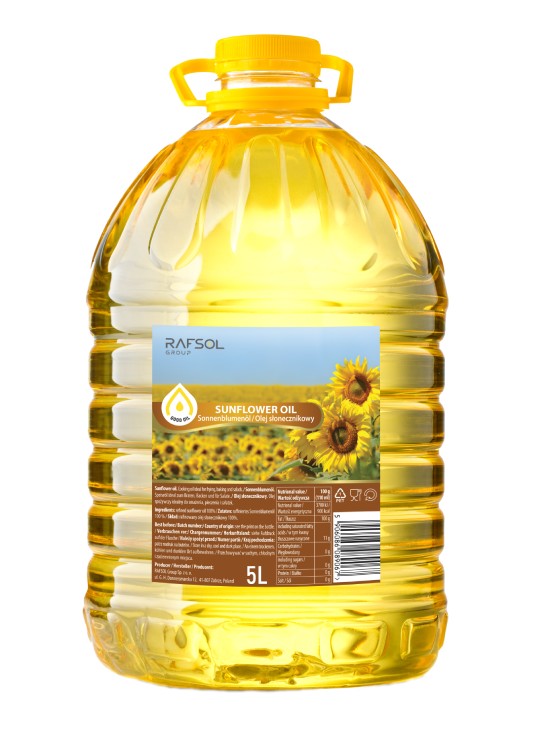
Sunflower oil 5 l is the format most frequently chosen by catering companies, restaurants and canteens. A pallet holds 120 bottles with a total capacity of 600 l. The 5 l bottle fits in a standard kitchen storeroom and is convenient to dispense – with a better price-to-volume ratio than the 3 l format.
The price of 5 l sunflower oil is lower per litre than that of the 3 l bottle. The 5 l bottle is the most popular format in B2B trade. Individual quotations are available on request.
Sunflower oil 10 l – the greatest efficiency in the bottle segment
Sunflower oil 10 l is the format with the lowest packaging cost per litre across the entire PET bottle segment. A pallet holds 72 bottles with a total capacity of 720 l. It is aimed at large mass-catering kitchens, industrial canteens and small production plants. Dispensing is done manually or through a standard tap – with no need to invest in pump infrastructure.
The price of 10 l sunflower oil is the lowest per litre of all the bottle formats. Current pricing on enquiry.
A note on 100 l sunflower oil: the 100 l format does not function as a standalone trade unit in wholesale. Orders of around 100 l are best met by ordering 10 l bottles (orders below a full pallet can be agreed) or – if monthly consumption exceeds 500–700 l – by considering a move to the 1000 l IBC as a more cost-efficient format.
Sunflower oil 1000 l – the IBC container for industrial plants
Sunflower oil 1000 l in an IBC container is a format dedicated to food industry plants with liquid-handling infrastructure. The target customers are manufacturers of sauces, dressings, canned goods, ready meals and snacks whose monthly sunflower oil consumption is measured in tonnes.
The IBC format is available in both the standard and the high-oleic version – allowing customers to choose the most suitable delivery format regardless of the oil variety.
—
IBC delivery logistics are described in the article: New in the offer: IBC containers
—
Sunflower oil 1000 l – price and delivery conditions
The price of sunflower oil in IBCs is markedly more favourable per litre than in the bottle formats. Prices differ between the standard and high-oleic versions – quotations are available on request.
Tanker deliveries of sunflower oil
Tanker deliveries of sunflower oil are dedicated to large production plants with their own storage tanks. Volumes are usually 25 tonnes; smaller quantities require an individual quotation. The tanker format eliminates packaging costs and provides the lowest unit cost in the entire range – for both the standard and the high-oleic variety.
Delivery schedules are agreed individually, with the option of fixed delivery cycles aligned with production schedules.
Sunflower oil price – what determines the quotation?
The price of sunflower oil in wholesale depends on several variables:
- Variety – high-oleic oil is more expensive than the standard variety owing to higher raw material and production process costs
- Packaging format – the larger the format, the lower the unit cost
- Volume and order frequency – annual contracts and regular deliveries translate into better terms
- Certification – non-GMO, Halal and Kosher affect the quotation
- Market quotations – sunflower oil prices are subject to seasonal and geopolitical fluctuations; the situation in the Ukrainian and Russian markets has a direct bearing on availability and prices in Europe
Rafsol Group does not publish price lists online. Current quotations are available on submission of an enquiry.
Sunflower oil manufacturer – buying directly from the producer
Rafsol Group is a sunflower oil manufacturer, not a distributor – which translates directly into prices and flexibility of cooperation terms:
- Direct manufacturer pricing with no distributor margin – the customer pays the manufacturer’s price
- Choice of variety and technical parameters – standard or high-oleic, tailored to your production process
- Private label – sunflower oil under the customer’s own brand in an agreed format and design
- Certification on request – non-GMO, Halal, Kosher
- Advice on oil selection – if it is not clear whether the standard or the HO variety is the better choice, Rafsol Group’s technologists will help you decide and arrange a sample before you order
Technical parameters of Rafsol sunflower oil
Rafsol sunflower oil is a refined sunflower oil available in two varieties: standard and high-oleic.
- The detailed composition, nutritional values and a comparison of both varieties are described in the article: Sunflower Oil – Properties
- Information on the production process is given in the article: How Is Sunflower Oil Made?
FAQ
What is the difference between standard and high-oleic sunflower oil?
Standard sunflower oil contains 50–70% linoleic acid (omega-6) and is characterised by lower thermal stability – it performs best in cold applications: dressings, marinades and sauces. High-oleic oil contains 75–90% oleic acid (omega-9), has markedly higher oxidative stability and is suitable for high-temperature frying and for the production of snacks and crisps.
What is the minimum order for sunflower oil in bottles?
The minimum order is agreed individually depending on the format and delivery logistics. Deliveries are usually made in pallet units. Details are available on request.
Is Rafsol sunflower oil available in a non-GMO or Halal version?
Yes – sunflower oil is available in certified versions: Halal and Kosher. The choice of certification affects the quotation and availability.
Does Rafsol offer sunflower oil under the customer’s own brand (private label)?
Yes – Rafsol Group fulfils private label orders for all sunflower oil bottle formats. Details of the label implementation process and minimum runs are available on request.
Which is better for frying – rapeseed or sunflower oil?
For high-temperature frying, rapeseed oil or high-oleic sunflower oil performs better – both are characterised by markedly higher oxidative stability than standard linoleic sunflower oil. The choice between them depends on the flavour requirements of the finished product and on the process specification. Rafsol Group’s technologists will help you select the right product for your specific application.
Looking for a sunflower oil manufacturer with a full range of formats and varieties matched to your process? Submit an enquiry – we will quote your order, advise on the choice between the standard and the high-oleic variety and select the packaging format to suit the scale of your plant.