


Knowledge base
Key takeaways:
- Fat degradation during frying proceeds along several routes at once – through oxidation, hydrolysis and polymerisation. Understanding these mechanisms allows frying fat to be selected deliberately for specific process conditions.
- The durability of frying fat depends not only on the composition of the raw material but also on temperature, the presence of water, the type of product being fried and the quality of oil management in the equipment.
- The key parameters for assessing stability are the total polar materials (TPM) figure, the acid value (FFA) and the fatty acid profile – in particular the content of polyunsaturated fatty acids.
- How often to change frying fat – there is no single rule, but there are measurable thresholds: European standards indicate 25% TPM as the point at which fat is disqualified. Regular measurement takes the guesswork out of the decision.
- Extending frying fat life is a genuine cost optimisation measure – appropriate fat selection and operational discipline can reduce feedstock consumption by as much as 30–40% (indicative figure).
What is the oxidative stability of frying fat and why does it matter in production?
The oxidative stability of frying fat is the ability of the fat to resist oxidation at elevated temperature in the presence of oxygen. The higher the stability, the more slowly degradation processes advance, the longer the fat retains its technological and sensory parameters – and the lower the unit cost of frying.
This parameter is directly linked to fatty acid composition. Fats rich in saturated fatty acids (palmitic, stearic) or in monounsaturated fatty acids (oleic) exhibit considerably higher stability than those with a high proportion of polyunsaturated fatty acids such as linoleic (C18:2) or linolenic (C18:3). This is why industrial frying fats are formulated to minimise PUFA content rather than maximise nutritional value.
The Rancimat test – how oxidative stability is measured
The standard laboratory tool for assessing oxidative stability is the Rancimat test (EN ISO 6886). The result – expressed as an induction time in hours – makes it possible to compare frying fats with one another under controlled conditions. For fats intended for intensive industrial frying, the desirable values are usually above 20–30 hours, although some specialised frying fats achieve considerably more.

Fat degradation during frying – three parallel processes
Fat degradation during frying is not a single process – it consists of overlapping chemical reactions whose rate depends on process conditions. Understanding each of them is a prerequisite for effective management of frying fat quality.
Thermal oxidation
Oxidation takes place where the fat comes into contact with atmospheric oxygen and is accelerated by high temperature. It produces primarily hydroperoxides, which then undergo further transformation into aldehydes, ketones and carboxylic acids. These compounds are responsible for the deterioration of the sensory characteristics of the fat – including the appearance of undesirable odours and flavours – and, as degradation advances, may lead to the formation of products with a potentially adverse effect on health. The more unsaturated double bonds there are in the triacylglycerol molecule, the faster oxidation proceeds.
Hydrolysis
Moisture released from the product being fried reacts with the fat, breaking down ester bonds and releasing free fatty acids (FFA). A rise in FFA lowers the smoke point of the frying fat and accelerates its further degradation. High-moisture foods – for example frozen chips or breaded fish – is one of the main factors accelerating fat consumption.
Polymerisation
At high temperatures, fat molecules combine to form dimers and polymers of high molecular weight. It is precisely these compounds that are responsible for the characteristic darkening of frying fat, the increase in viscosity and the foaming of the oil. They are among the most visible organoleptic indicators of fat exhaustion and can be assessed without measuring equipment. At an advanced stage of degradation, polymerisation leads to the formation of deposits and lacquering, which further reduce heat transfer efficiency and impair the stability of the frying process.
| Process | Main cause | Analytical indicator | Operational consequence |
|---|---|---|---|
| Oxidation | Oxygen + high temperature | Peroxide value, p-AV | Deterioration of taste and odour, formation of potentially harmful substances |
| Hydrolysis | Water from the product | FFA | Lower smoke point, accelerated degradation |
| Polymerisation | High temperature and time | TPM, viscosity | Foaming, darkening, increased viscosity, formation of deposits |
The durability of frying fat – what actually shortens frying fat life
The durability of frying fat is the net result of feedstock-related and process-related factors. Even the highest-quality frying fats will degrade rapidly under incorrect operating conditions.
Factors that shorten frying fat life:
- Excessive temperature – every 10°C above the recommended range can significantly increase the rate of oxidation; frying at 185–190°C instead of 170–175°C drastically shortens the service life of the fat
- Running the fryer idle – heated fat with no product in it oxidises more intensively; equipment should be switched off or run at a lower temperature during breaks
- Product residues and crumbs – these catalyse oxidation and polymerisation reactions, so regular filtration is essential
- Contact with metals – copper and iron act as pro-oxidants; the material the equipment is made of matters
- Overloading with product at once – the sudden release of water causes a local increase in free fatty acids (FFA)
- Unsuitable frying fat composition – a high PUFA content and the absence of natural or added antioxidants
How often to change frying fat – thresholds and control methods
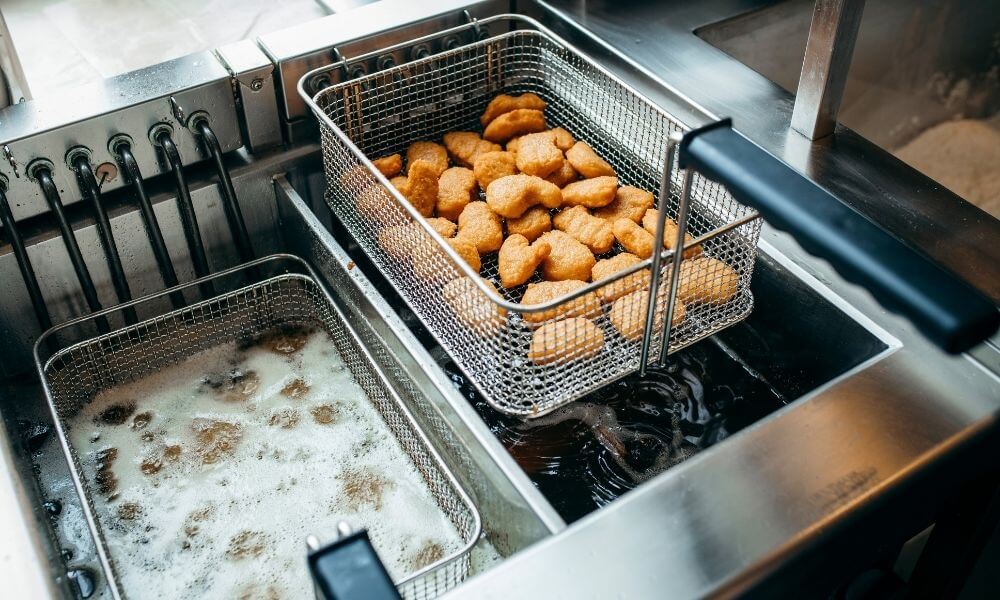
How often to change frying fat is a question that, in a professional production environment, should not be answered intuitively – it should be based on measurement. Changing too early generates unnecessary costs; changing too late creates quality and legal risk.
Standards and disqualifying indicators
European legislation (including Codex Alimentarius guidelines and national sanitary regulations) indicates a level of 25% TPM (Total Polar Materials) as the threshold above which the fat should be replaced. In Germany this limit is enforced through inspections; in Poland it is commonly used as a reference in HACCP systems.
Supporting indicators:
- FFA above 1.0–2.5% (depending on the type of fat and the requirements of the plant)
- An acid value above 2–5 mg KOH/g
- Visible foaming, dark colour and an intense unpleasant odour – visual and sensory signals as a supplement to measurement
Field tests – rapid checks without a laboratory
Test strips and digital TPM meters (such as the testo 270 or Fri-Check) are available on the market and make it possible to check the condition of the fat directly at the fryer within seconds. In plants with a high turnover of fried products, measurement is recommended at least twice a day, at the beginning and towards the end of the production shift.
Extending frying fat life – practical operational measures
Extending frying fat life is achievable without changing supplier or rebuilding the production line – consistent operational discipline and the right choice of feedstock are enough.
Measures relating to equipment management:
- Filter the fat at least once a day (or after every shift in intensive production) – removing solid particles reduces the rate of polymerisation
- Keep the frying temperature within the range recommended by the frying fat manufacturer – no higher than necessary
- Switch off the fryer or reduce its temperature during breaks longer than 20–30 minutes
- Top up with fresh fat as levels fall rather than carrying out infrequent full changes – continuous replenishment keeps the average age of the fat low
Measures relating to feedstock selection:
- Choose a frying fat with a high proportion of monounsaturated fatty acids (oleic, C18:1) – for example frying fats based on high-oleic (HO) sunflower oil or palm olein
- Frying fats with natural antioxidants (tocopherols) or synthetic ones (TBHQ, BHA – at legally permitted concentrations) – these slow oxidation down
- Match the frying fat to the specific application: a wet breaded product requires a different specification from dry snack products
—
Also read: Frying fat – how to select the right frying medium and where to buy foodservice frying fats and How the Vegetable Oil Is Made
—
Frying fat composition and stability – what to check when selecting a supplier
The oxidative stability of frying fat should be verifiable through documentation, not merely declared verbally. When comparing supplier offers, it is worth requiring the following data:
| Parameter | What to check | Benchmark for industrial frying fat |
|---|---|---|
| Fatty acid profile | C18:2 (linoleic) content | Below 15–20% for a stable frying fat |
| FFA (free fatty acids) | % as oleic acid in the fresh product | Below 0.1% for refined oil |
| Smoke point | °C | Min. 210–220°C |
| Antioxidant content | Type and concentration | Compliance with EU Regulation 1333/2008 |
FAQ – oxidative stability of frying fat
What is the difference between frying fat and frying oil in terms of oxidative stability?
Industrial frying fats are deliberately formulated for high oxidative stability – often through fractionation, enzymatic or chemical interesterification and the selection of feedstocks with a low PUFA content. Standard vegetable oils (such as classic refined sunflower oil) have a higher proportion of polyunsaturated fatty acids and degrade more quickly at frying temperature. In professional catering and production applications the difference in operating costs can be significant.
Do hydrogenated frying fats have higher stability than non-hydrogenated ones?
Historically, yes – partial or full hydrogenation increases oxidative stability by reducing double bonds. However, traditional partial hydrogenation generates trans isomers, which are limited or eliminated in modern frying fats. An alternative is frying fats based on interesterification and fractionation, which combine high stability with a trans-free profile.
What does TPM mean and how is it measured in practice in a production plant?
TPM (Total Polar Materials) is the combined content of polar compounds formed as a result of fat degradation – hydrolysis, oxidation and polymerisation. The 25% TPM threshold is the European standard for disqualifying frying fat. In practice it is measured with a digital meter (such as the testo 270) directly in the fryer – the measurement takes a few seconds and requires no laboratory.
Does the type of product being fried affect the rate of frying fat degradation?
Very much so. Products with a high moisture content (frozen chips, fish, vegetables) hydrolyse the fat intensively and shorten its life. Dry products (crisps, snacks) are far gentler on the frying fat. The choice of frying fat should take account of the specific range of products being fried – frying fats for wet applications usually have a different composition and a higher smoke point.
Does topping up with fresh fat really extend frying fat life?
Yes – systematically topping up losses with fresh fat (the continuous replenishment method) maintains a lower average TPM level than a strategy of infrequent full changes. In large production plants and high-turnover frying operations this is a standard optimisation practice.
Selecting the right frying fat for a specific frying process – taking into account composition, oxidative stability and operating conditions – is a decision with a real impact on production costs and on the quality of the final product. If your plant is struggling with rapid fat degradation, foaming of the frying fat or difficulties in maintaining consistent quality in the fried product, please get in touch.
Our technologists will analyse your application and propose a frying fat matched to your process, certification and cost requirements.