


Knowledge base

Refined rapeseed oil is the most widely used type of rapeseed oil in the food industry and in catering – obtained through a multi-stage refining process that neutralises the taste, odour and colour of the crude oils while raising its thermal stability and shelf life. Rafsol Group produces and supplies refined rapeseed oil to B2B customers in 26 European countries.
- Rapeseed oil refining covers the stages of degumming, neutralisation, bleaching and deodorisation – the result is a raw material with a neutral flavour profile, light colour and high oxidative stability, ready for industrial and catering applications.
- The smoke point of rapeseed frying oil is approximately 230°C – which makes it a thermally stable vegetable oil available on the wholesale market and ideally suited to high-temperature frying.
- Refined rapeseed oil is commonly used both in catering and in the food industry – as a base for frying fats, a raw material for processed food production and a component of oil blends.
- The question of whether refined rapeseed oil is healthy has a complex answer – refining reduces the content of certain bioactive compounds but retains the favourable fatty acid profile; we discuss this in detail in a separate article.
- Refined rapeseed oil is available from Rafsol in 3 l, 5 l and 10 l PET bottles, 1000 l IBC containers and in tanker deliveries – with certification options, Halal and Kosher.
Refined rapeseed oil – how does it differ from unrefined oil?
Refined rapeseed oil is produced from crude rapeseed oil subjected to an industrial purification process that removes the accompanying substances affecting the taste, odour, colour and shelf life of the oil. Before it enters refining, crude rapeseed oil contains phospholipids, free fatty acids, chlorophyll pigments, oxidation products and odour compounds which, in unrefined form, limit the scope for industrial use.
Key differences between refined and unrefined oil:
| Property | Refined rapeseed oil | Unrefined (crude) oil |
|---|---|---|
| Taste and odour | Neutral | Pronounced, characteristic |
| Colour | Light straw | Dark yellow to greenish-brown |
| Smoke point | Approximately 230°C | 130–160°C |
| Oxidative stability | High | Low |
| Shelf life | Long | Short |
| Application | Cold and hot: industry, catering, frying | Cold applications only |
Refined rapeseed oil is widely used across industry – unlike cold-pressed oils, which, owing to their low thermal stability and short shelf life, have limited technological application at B2B scale. Rafsol Group supplies refined rapeseed oil exclusively – no cold-pressed oils, as these do not fit the profile of industrial production.
—
Also read: How Is Rapeseed Oil Made
—
Refined rapeseed oil – composition and properties
Refined rapeseed oil retains the favourable fatty acid profile of the crude oil – a high content of monounsaturated oleic acid (55–65%), a low content of saturated fatty acids (below 7%) and a favourable omega-3 to omega-6 ratio (approximately 1:2). The refining process does not alter this profile – it affects only the taste, odour, colour and thermal stability of the oil, which we describe in more detail in the next section.
The full fatty acid breakdown, nutritional values and industrial applications of rapeseed oil are described in detail in the article:

Smoke point of refined rapeseed oil – a key technological parameter
The smoke point of refined rapeseed oil is approximately 230°C and is one of the highest figures among commonly used vegetable oils. This parameter carries direct technological significance – it defines the upper limit for the safe use of the oil in thermal processes, above which fat breakdown occurs, along with the formation of volatile compounds, including acrolein, and of oxidation products such as free radicals. These processes lead to a deterioration in sensory characteristics and a reduction in the nutritional value of the finished product.
Such a high smoke point in refined rapeseed oil results primarily from the refining process – removing free fatty acids and accompanying substances, which are the first link in thermal degradation, raises the stability of the product by several dozen degrees compared with the unrefined version.
The smoke point of refined rapeseed oil and raw material selection for the process
The smoke point of refined rapeseed oil at 220–230°C allows it to be used in deep-fat frying (fryers, industrial frying kettles), griddle frying and blanching. The temperatures typically applied in these processes fall within the range of 160–190°C, which provides an adequate safety margin relative to the smoke point of fresh oil.
By way of comparison, standard (linoleic) sunflower oil has a smoke point of approximately 200–220°C, whereas cold-pressed oils often begin to smoke and degrade at 130–160°C. In industrial practice, refined rapeseed oil is one of the most frequently selected frying media precisely because it combines a high smoke point with a low unit price and wide availability.
It is worth remembering, however, that the smoke point values quoted apply to fresh oil – every subsequent use in the frying process lowers the stability Monitoring the TPM (total polar materials) indicator makes it possible to control oil life within the production process. We devote a separate item in the Knowledge Base to oxidative stability and the life of frying fats:

Refined rapeseed oil for frying – applications in catering and the food industry
Refined rapeseed oil used for frying is in practice the most common application of this product – both in catering and in the food industry. A high smoke point, neutral taste, availability in wholesale formats and a competitive price make it the dominant choice in the deep-frying and shallow-frying categories.
Principal industrial and catering applications:
- Fryers and industrial frying kettles – frying chips, breaded meat and fish products, doughnuts and angel wings
- Griddle and wok frying – restaurants, canteens, industrial catering
- Production of ready-made frying fats – a base for frying blends containing rapeseed oil
- Production of canned goods and ready meals – as a frying medium for ingredients or as a recipe component
- Frying snacks and crisps – used in blends with high-oleic sunflower oil or as a standalone oil
- Production of mayonnaise, sauces and dressings – as a base raw material in emulsion formulations
For customers in the HoReCa segments, refined rapeseed oil is the most frequently ordered product across the entire oil range.
Is refined rapeseed oil healthy?
Is refined rapeseed oil healthy? This question regularly arises in a purchasing context among both consumers and professional buyers in the food sector. The current state of knowledge indicates that the refining process does not fundamentally change the favourable fatty acid profile of rapeseed oil, although it does lead to a partial reduction in certain bioactive compounds such as tocopherols, phytosterols and phenolic compounds, which are present in larger quantities in unrefined oil.

Refined rapeseed oil retains the most important nutritional characteristics:
- a favourable omega-3 to omega-6 ratio (approximately 1:2)
- a low content of saturated fatty acids (below 7%)
- the presence of vitamin E (tocopherols, albeit in smaller quantities than in crude oil)
Refining, on the other hand, removes accompanying substances – including free fatty acids, phospholipids, pigments, compounds responsible for undesirable aromas and some of the antinutritional compounds present in the raw material – whose presence in crude rapeseed oil is undesirable both technologically and nutritionally.
The subject of the health properties of rapeseed oil – together with a comparison with other vegetable oils and a discussion of its composition in a nutritional context – is covered in detail in the article:
Refined rapeseed oil – available wholesale packaging
Refined rapeseed oil is available from Rafsol Group across the full range of wholesale formats. Refined rapeseed oil in 3 l and 5 l PET bottles is dedicated to catering and HoReCa (pallets of 648 l and 600 l), refined rapeseed oil in 10 l offers the most favourable unit cost in the bottle segment (pallet of 720 l), while refined rapeseed oil in 1000 l IBC containers and tanker deliveries (from approximately 20,000 l) serve industrial customers with higher requirements.
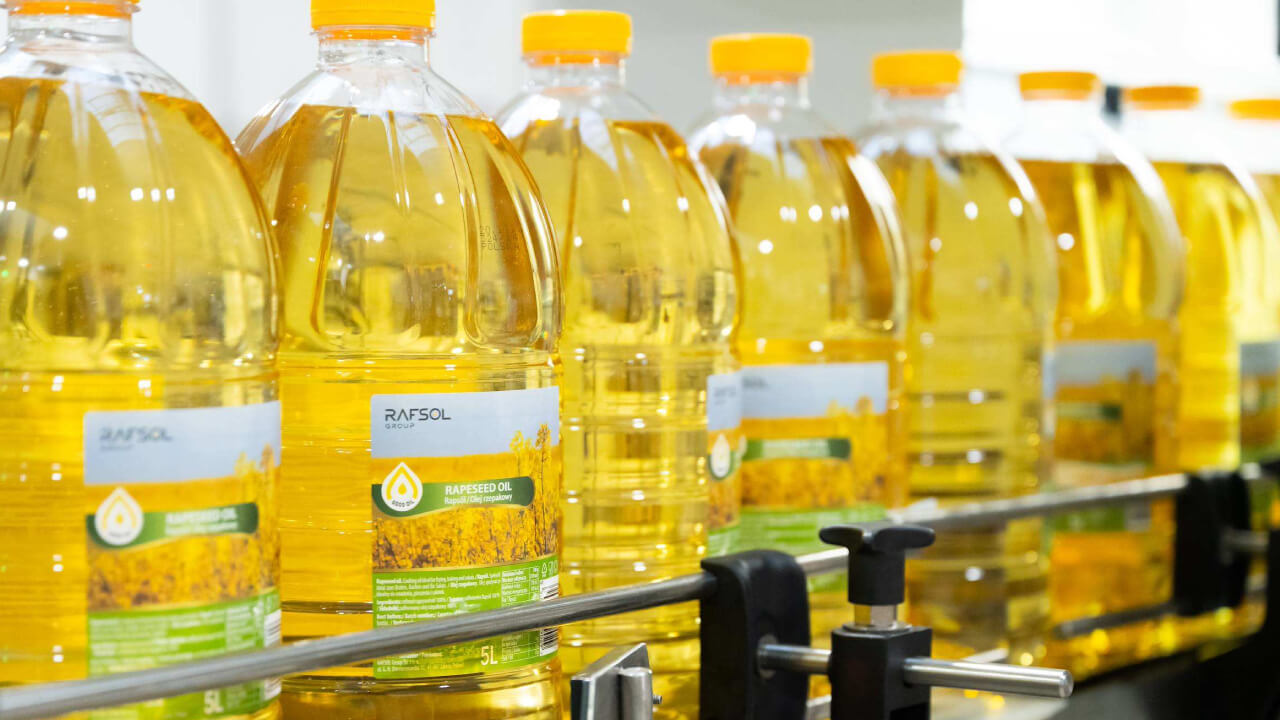
A detailed overview of all formats, pallet capacities and order conditions is available in the article:
Refined rapeseed oil – manufacturer and wholesale purchase
Rafsol Group is a manufacturer of refined rapeseed oil offering direct supply to B2B customers in Poland and 26 European countries. Buying directly from the manufacturer means no distribution margin, the option to agree the technical parameters of the oils and access to a full certification package.
Available options:
- Standard refined rapeseed oil – wide availability, fast lead times
- Rafsol Group offers non-GMO versions only
- Halal and Kosher certificates – for exporters serving markets that require religious certification
- Private label – refined rapeseed oil under the customer’s own brand, in any bottle format
FAQ
How does refined rapeseed oil differ from cold-pressed oil?
Cold-pressed rapeseed oil is produced by mechanically pressing the seeds without heating – it retains more bioactive compounds but has a low smoke point (approximately 130–160°C), a short shelf life and a pronounced taste. Refined rapeseed oil undergoes a multi-stage purification process that raises the smoke point to approximately 230°C, neutralises taste and odour and significantly extends shelf life. Only refined oil is used in industrial and catering applications.
What is the smoke point of refined rapeseed oil?
The smoke point of refined rapeseed oil is approximately 230°C, depending on the quality of the raw material, the degree of refining and the method used to determine this parameter. It is one of the highest figures among popular vegetable oils, which makes it ideally suited to deep-fat frying and other high-temperature thermal processes.
Is refined rapeseed oil suitable for deep-fat frying?
Yes – a high smoke point, neutral taste and relatively low wholesale price make refined rapeseed oil one of the most frequently used frying media in catering and the food industry. It performs well both in catering fryers and in industrial frying kettles.
Is refined rapeseed oil healthy?
Refining does not significantly alter the favourable fatty acid profile of rapeseed oil – the low content of saturated fatty acids and the favourable omega-3 to omega-6 ratio are retained. Refining does, however, reduce some bioactive compounds (tocopherols, phytosterols and phenolic compounds), while at the same time increasing the stability and shelf life of the oil. A detailed discussion of this subject can be found in the article Is Rapeseed Oil Healthy?.
In what packaging is refined rapeseed oil available from Rafsol?
Rafsol Group supplies refined rapeseed oil in 3 l, 5 l and 10 l PET bottles (pallet deliveries), 1000 l IBC containers and tanker deliveries for large industrial customers. A full overview of formats and delivery conditions is available in the article Rapeseed oil wholesale – 3 l, 5 l and 10 l bottles, 1000 l IBC and tanker deliveries.
Is refined rapeseed oil available in a non-GMO version or with Halal and Kosher certification?
Yes – Rafsol Group offers refined rapeseed oil in a non-GMO version and in a Halal and Kosher certified version. The choice of certification affects pricing and lead times.
Looking for a refined rapeseed oil manufacturer with an offer matched to the scale of your production? Submit an enquiry – we will quote the feedstock in your chosen packaging format, advise on the selection of certification and guide you through the entire process from sample to regular supply. Submit an enquiry.