


Knowledge base
In this article you will learn:
- what industrial margarine is made from,
- what function each ingredient performs,
- how hydrogenation, interesterification and fractionation differ,
- how margarine production works step by step,
- why crystallisation has such a strong influence on the properties of the finished product,
- which factors affect the price of industrial margarine.
What is margarine made from? The raw material base and why it matters
Industrial margarine is a water-in-oil (W/O) emulsion. Its base consists of carefully selected vegetable oils and fats, while the aqueous phase contains ingredients responsible for, among other things, flavour, stability and shelf life.
It is the proportions of the individual raw materials, and above all the composition of the fat phase, that largely determine how the margarine will behave during further processing – for example in a bakery, a patisserie or a food production plant.
—
Also read: Palm-Free Margarine – How to Select a Palm-Free Fat for Bakeries and Confectioneries
—
The fat phase – the foundation of the formulation
The fat phase may consist of one or several vegetable oils and fats. These are selected so as to achieve the required SFC (Solid Fat Content) profile, melting point and desired plasticity.
Formulations use, among others:
- liquid oils, such as rapeseed or sunflower oil – these form the liquid part of the fat phase and allow the hardness of the product to be adjusted;
- solid fats and their fractions, such as palm or palm kernel fats – these are responsible for structure and plasticity;
- emulsifiers, such as mono- and diglycerides of fatty acids or lecithin – these help maintain a stable emulsion;
- vitamins A and D – used depending on the formulation and the requirements of the target market;
- β-carotene – used to obtain the characteristic colour of the product.
Selecting these ingredients correctly translates directly into how the margarine behaves during sheeting, aeration, baking and storage.
The aqueous phase – less visible, but equally important
The aqueous phase influences flavour, microbiological stability and product structure, among other properties. It may contain water, salt, acidity regulators, flavourings and – depending on the formulation – dairy ingredients.
Although it accounts for a smaller share of the product than the fat phase, preparing it correctly is highly important for the stability of the entire emulsion.
How are fats modified for margarine production?
Liquid vegetable oils on their own do not provide the structure required of most industrial margarines. The properties of the fat base are therefore adjusted to achieve the appropriate hardness, plasticity and melting profile.
Industry relies primarily on three methods for this purpose.
Hydrogenation
Hydrogenation involves adding hydrogen to the unsaturated bonds of fatty acids in the presence of a catalyst. The process increases the hardness and stability of the fat.
It is worth distinguishing, however, between full and partial hydrogenation. The latter can lead to the formation of trans isomers, which is why its role in food production in the European Union has been considerably restricted.
Modern margarine formulations make it possible to achieve the required structure by other means as well, without the need for partially hydrogenated fats.
Interesterification
Interesterification makes it possible to rearrange fatty acids within triglyceride molecules and thereby modify the physical properties of the fat.
Enzymatic interesterification uses specifically selected enzymes. This allows the melting profile and consistency of the fat base to be engineered without forming industrial trans fatty acids.
Fractionation
Fractionation is a physical process in which a fat is separated into fractions with different thermal properties.
Palm oil is a good example. Fractionation can yield a harder stearin and a more fluid olein, among other fractions. Blending fractions in the right proportions makes it possible to shape the properties of the finished fat base precisely.
What does margarine production look like step by step?
Margarine is produced under strictly controlled conditions. Temperature, mixing intensity and cooling rate all affect the final structure of the product.
A typical process comprises:
| Stage | Typical temperature | Purpose |
|---|---|---|
| Fat phase preparation | 50–65°C | Melting the ingredients and dosing the additives |
| Aqueous phase preparation | 60–70°C | Dissolving the ingredients and preparing the phase |
| Emulsification | 40–65°C | Forming a stable W/O emulsion |
| Pasteurisation | 85–90°C | Improving microbiological safety |
| Crystallisation | −5 to +15°C | Forming the appropriate crystal structure |
| Plasticisation | 15–25°C | Giving the product its final consistency |
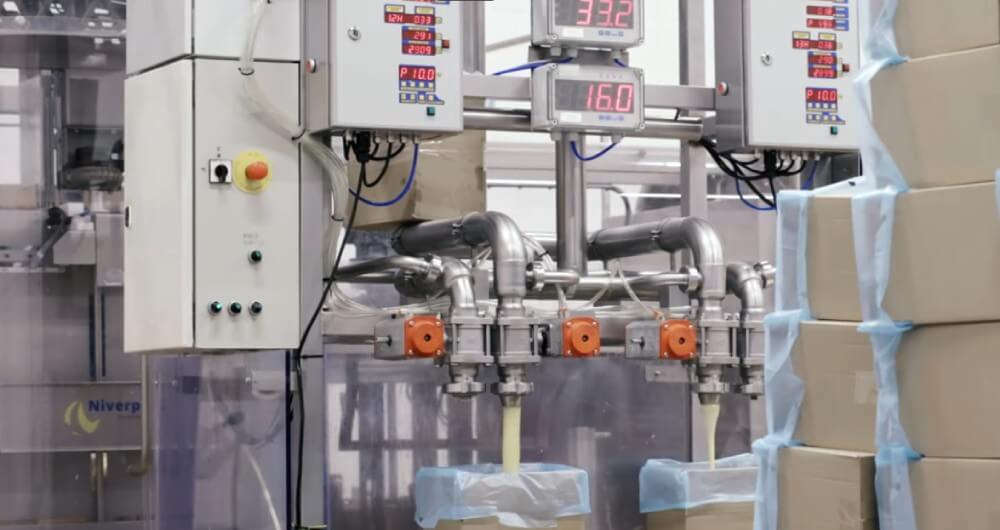
| Forming and packing | depends on the product | Preparing the product for storage and transport |
The temperature ranges given are indicative – the exact parameters depend on the formulation, the installation and the expected properties of the product.
Emulsification – the moment at which the actual structure of the product is formed
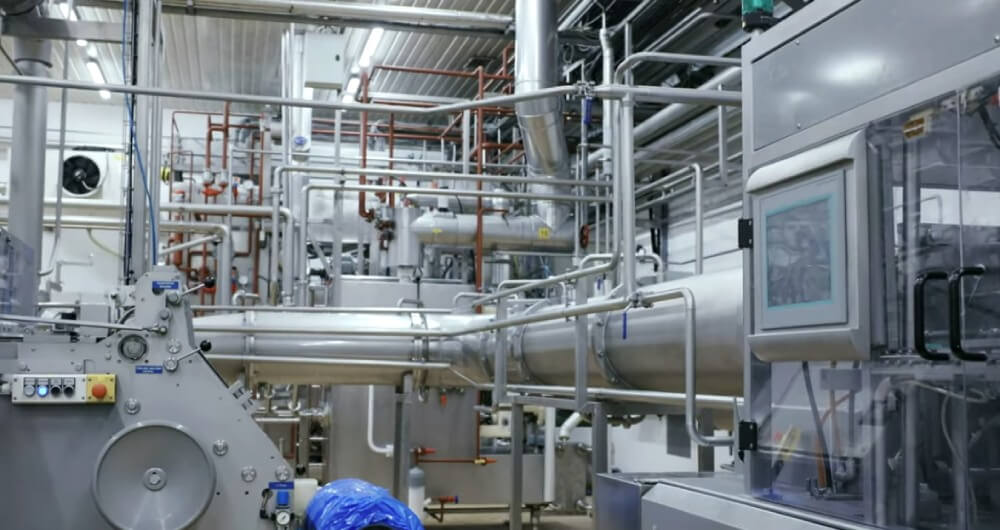
During emulsification the aqueous phase is evenly dispersed in the fat phase. The process requires control of temperature, of the ratio between the two phases and of the choice of emulsifiers.
Why does this matter so much?
An unstable emulsion can lead to phase separation, uneven texture and problems during the subsequent storage and use of the margarine.
Crystallisation – the stage that determines consistency
One of the most important moments in production is the rapid cooling of the emulsion in a heat exchanger, namely an SSHE (Scraped Surface Heat Exchanger).
As the emulsion cools, fat crystals begin to form. By controlling the temperature, the cooling rate and the mixing intensity, the margarine manufacturer can influence their size and form and, as a result, the hardness, smoothness and plasticity of the margarine.
This is precisely why two margarines with seemingly similar compositions can behave entirely differently during sheeting, aeration or baking.
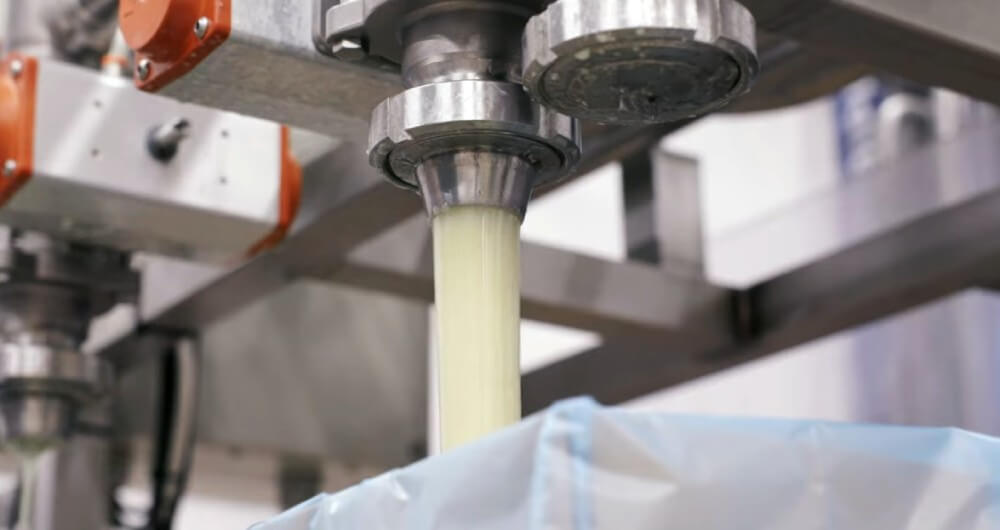
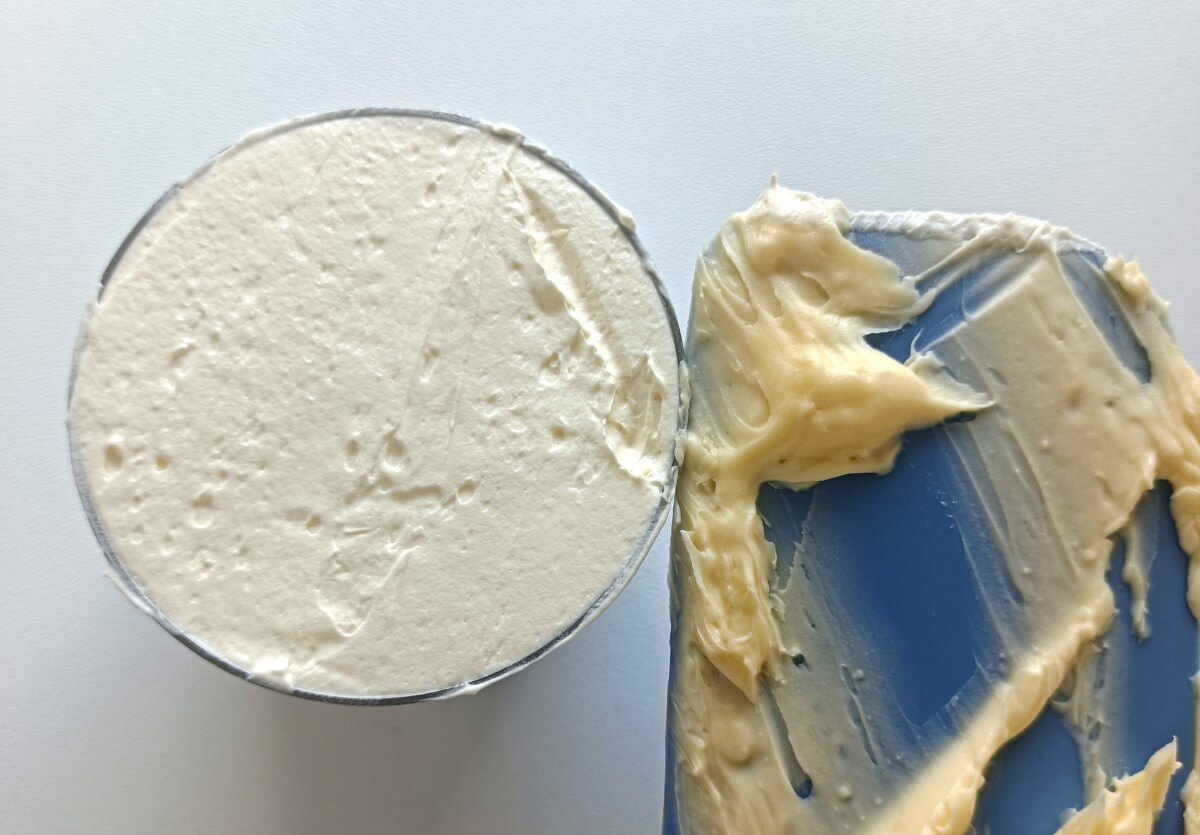
After crystallisation the product may undergo further mechanical plasticisation and is then formed into blocks or cubes, or filled into pails or other industrial packaging.
The next stage is maturation of the fat structure at a controlled temperature. This stabilises the properties of the product before dispatch and use by the customer.
Industrial margarines – formulations matched to the application
For B2B customers there is no single universal margarine suitable for every process.
A laminating margarine used in the production of croissants and puff pastry requires different properties from a product intended for creams, and different properties again from a margarine used in bread or fillings.
Industrial formulations can therefore be designed around parameters such as:
- SFC profile,
- melting point,
- plasticity,
- fatty acid composition,
- the presence or absence of palm oil,
- required certifications,
- packaging and delivery format.
Polish margarine manufacturers offer palm-free variants, products based on RSPO-certified raw materials, and solutions compliant with halal and kosher requirements or with organic production, among others.
What determines the price of industrial margarine?
The price of margarine in the B2B segment does not depend solely on the price of the base oil. The final cost is influenced by the entire formulation as well as by the method of production and delivery.
The most important factors include:
- raw material composition – the use of specialist fractions and components can increase the cost of the formulation;
- fat modification method – the individual technologies differ in process cost;
- certification – requirements such as RSPO, BIO (organic), halal or kosher may entail additional raw material and control costs;
- delivery format – the unit cost of the product may differ depending on whether the margarine is supplied in blocks, pails or larger industrial packaging;
- order volume and regularity – larger, repeat deliveries usually offer greater scope for cost optimisation.
In practice, when comparing offers it is therefore worth analysing not only the price per kilogram, but also the technological parameters of the product, its performance in the specific application and the logistics terms.
FAQ – margarine production
What is industrial margarine made from?
The base consists of carefully selected vegetable oils together with solid or modified fats. The formulation is completed with emulsifiers, salt, acidity regulators, vitamins and flavourings, among other ingredients.
The exact composition depends on the intended use of the product. A laminating margarine will have different parameters from a product intended for creams or baked goods.
Does industrial margarine contain trans fatty acids?
Modern technologies make it possible to produce margarines without partially hydrogenated fats, which were the main industrial source of trans isomers. The required structure can be achieved through fractionation and interesterification, among other methods.
How long does margarine production take?
The technological process itself – from raw material preparation to packing – can take several hours. The process does not end there, however.
For some products, maturation of the crystal structure at a controlled temperature is also important. Only once it has stabilised does the margarine acquire the properties required in a given application.
Can margarine be produced to a customer’s specification?
Yes. In the B2B segment it is possible to develop a product to defined technological requirements, for example SFC profile, melting point, raw material composition, required certifications or packaging format.
Rafsol Group also offers the option of preparing solutions tailored to specific industrial applications and to customer requirements.
Which certifications matter when choosing a margarine manufacturer?
The scope of certification required depends on the market, the customer and the raw materials used. In the food industry, food safety and quality systems such as BRCGS and IFS are of particular importance.
Depending on the market and the formulation, RSPO, BIO, halal or kosher certifications may also be relevant.
When selecting a supplier or a margarine manufacturer it is therefore worth checking not only whether a certificate is held, but also its scope and its alignment with the requirements of the specific product and target market.