


Knowledge base

Key takeaways:
The SFC (Solid Fat Content) profile is a parameter that expresses what proportion of the fat in a product is in crystalline form at a given temperature, stated as a percentage. For example, SFC 20°C = 28% means that at 20°C as much as 28% of the fat is in the solid (crystalline) phase, while the remaining 72% is in the liquid phase.
Why does this matter? Because the ratio of the solid to the liquid phase determines:
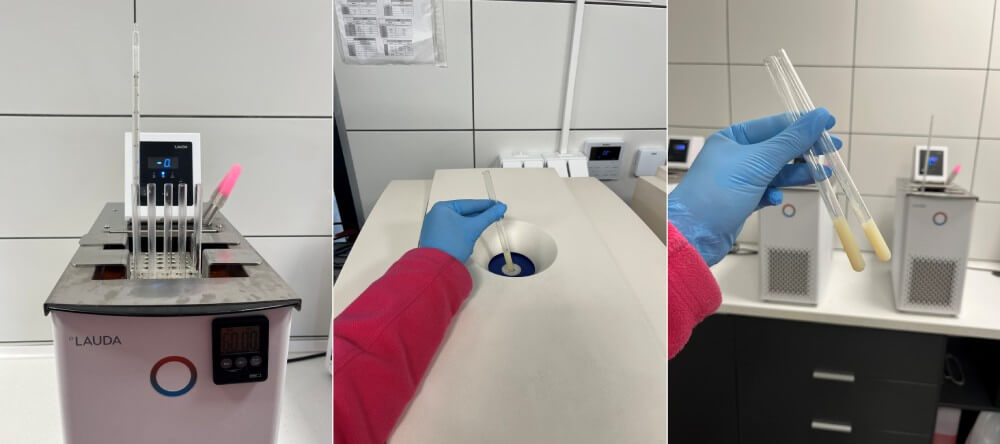
 Solid fat content is measured by pulsed nuclear magnetic resonance (p-NMR), e.g. in accordance with ISO 8292-1 or IUPAC 2.150. The measurement analyses signals from protons in the solid and liquid phases of the fat, which differ in their relaxation properties. On this basis, the proportion of the solid phase in the sample at a given temperature is determined.
In practice, other measurement points may also be relevant, depending on the application.
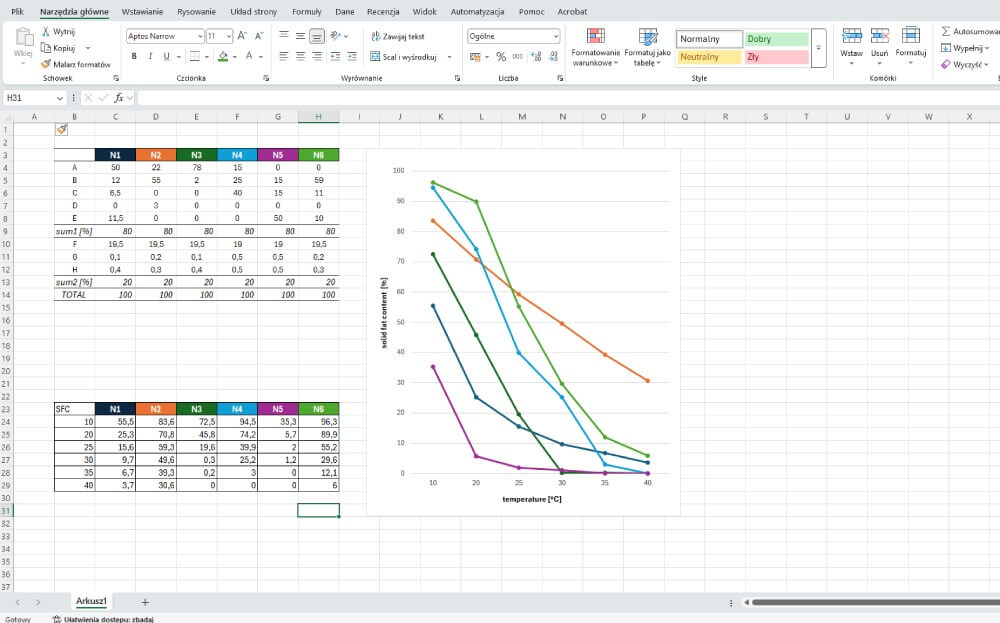 It should be borne in mind that SFC is an important predictor of mechanical properties. However, the final plasticity of a margarine is also influenced by triacylglycerol composition, crystal size distribution, polymorphic form, cooling method, pin-working, thermal history, crystal network structure, emulsion composition, and the proportion and structure of the aqueous phase.
The product specification (e.g. the TDS) is the core document on which fat selection for a process is based. A complete and reliable specification for a bakery and confectionery margarine should include:
The absence of a full SFC curve, or giving SFC at 20°C only, limits the ability to fully assess how the margarine behaves across the range of process temperatures. For applications that require precise matching of fat properties, it is worth asking the supplier for a more complete SFC profile and for information on the recommended working temperature range. In contract purchasing, key elements of the documentation are an up-to-date TDS and an agreed range of parameters confirmed in the certificate of analysis (CoA).
The SFC profile must be interpreted in the context of actual temperature conditions in the plant, not in a laboratory vacuum. In Polish bakeries and patisseries, the temperature in the production area in summer often exceeds 24–28°C – which can completely change how the margarine behaves.
Example: a laminating margarine with SFC 25°C = 10% is very soft at this temperature and prone to fat leakage between the layers. When buying laminating margarine for a plant without air conditioning, or for delivery in the summer months, it is advisable to require SFC 25°C > 14–16% and to discuss the working temperature range with the supplier’s technologist.
Plants with air-conditioned lamination areas (maintained at 15–18°C) can use margarines with a lower SFC at 25°C, which often translates into a better melt-in-the-mouth profile and a less waxy sensory perception of the finished product.
SFC (Solid Fat Content) is a parameter expressing the percentage of solid, crystallised fat at a given temperature. It is expressed as a percentage and measured by pulsed NMR (p-NMR) in accordance with ISO 8292. As a rule, the higher the SFC at a given temperature, the harder and less plastic the margarine is at that temperature.
There is no single universal SFC value at 20°C that suits all laminating margarines. The optimum SFC profile depends on factors including the margarine and dough formulation, the type of product, dough and fat temperature, ambient temperature and lamination process parameters. SFC should therefore always be interpreted in the context of the specific application and production conditions, not as a stand-alone margarine quality criterion.
SFC is determined by pulsed NMR in accordance with the relevant analytical procedure, e.g. ISO 8292. The way the sample is prepared and thermally conditioned before measurement has a significant effect on the result, particularly for fats that exhibit polymorphism. Therefore, when comparing SFC results for different products or suppliers, make sure they were determined using the same method and a comparable sample preparation procedure.
A good laminating margarine specification should contain parameters that allow its suitability for a specific application and process conditions to be assessed, including information on the properties of the fat and how it behaves at different temperatures. Helpful parameters include the SFC profile, melting point and consistency parameters. The scope of available data may vary depending on the manufacturer and product, so the absence of a single parameter from a standard specification should not automatically be treated as a sign of low quality. If necessary, ask the supplier for additional technical data and discuss the recommended conditions of use for the margarine.
Full specifications and certificates of analysis (CoA) with SFC profiles are available for every product in our range. Submit a request for quotation – our technical department will send you the documentation within 24 working hours.
- The SFC profile is a series of solid fat content measurements (%) at set temperatures – most commonly 10, 20, 25, 30 and 35°C – with each temperature revealing a different aspect of how the margarine behaves during processing and baking.
- Solid fat content is measured by pulsed NMR (p-NMR) in accordance with ISO 8292; the measurement method (indirect or direct) has a significant effect on the results and is selected according to the type of raw material being tested.
- Different margarines have different melting profiles – each application requires an entirely different curve.
- The polymorphic form of the crystals plays a key role: β′ (beta prime) crystals promote a smooth, plastic texture, while β (beta) crystals can lead to changes in hardness and texture, thereby affecting properties that are critical in lamination.
- A good technical data sheet or specification for a bakery margarine includes the full SFC profile (at least 3 temperatures), the slip melting point (SMP), the trans fatty acid content and other product-specific information.
—
Also read: Margarine production step by step – how is industrial margarine made?
—
What the SFC profile is and why it determines margarine performance in production
The SFC (Solid Fat Content) profile is a parameter that expresses what proportion of the fat in a product is in crystalline form at a given temperature, stated as a percentage. For example, SFC 20°C = 28% means that at 20°C as much as 28% of the fat is in the solid (crystalline) phase, while the remaining 72% is in the liquid phase.
Why does this matter? Because the ratio of the solid to the liquid phase determines:
- plasticity – the ability to deform without cracking (essential for sheeting and lamination)
- hardness – mechanical resistance to compression (determines how a block of margarine behaves straight out of cold storage)
- baking performance – the fat must melt at the right moment, neither too early nor too late
- mouthfeel – no waxiness in the finished product (complete melting at body temperature, ~37°C)
Solid fat content is measured by pulsed nuclear magnetic resonance (p-NMR), e.g. in accordance with ISO 8292-1 or IUPAC 2.150. The measurement analyses signals from protons in the solid and liquid phases of the fat, which differ in their relaxation properties. On this basis, the proportion of the solid phase in the sample at a given temperature is determined.
How to read the SFC curve – point by point
The SFC curve usually consists of 5 measurement points. Each describes a different aspect of how the margarine behaves in the production process:| Temperature | What it indicates | Practical significance |
|---|---|---|
| SFC 10°C | Hardness “straight from cold storage” | Too high (>50%) = margarine difficult to remove from packaging and to cut; risk of dough tearing |
| SFC 20°C | Indicator of consistency/plasticity within the working temperature range | Key parameter for lamination and sheeting; too low = fat leakage between layers; the further processing temperature for most margarines |
| SFC 30°C | Behaviour in warm dough | Determines fat leakage at higher dough and layer temperatures |
| SFC 35°C | One of the indicators of waxiness in the mouth | Should be < 5–8% to avoid a waxy effect |
It should be borne in mind that SFC is an important predictor of mechanical properties. However, the final plasticity of a margarine is also influenced by triacylglycerol composition, crystal size distribution, polymorphic form, cooling method, pin-working, thermal history, crystal network structure, emulsion composition, and the proportion and structure of the aqueous phase.
Interpreting the SFC profile for different bakery applications
There is no single “correct” SFC profile – each application requires different curve characteristics. The table shows typical SFC ranges found in fats for various applications:| Application | SFC 10°C | SFC 20°C | SFC 30°C | SFC 35°C |
|---|---|---|---|---|
| Laminating margarine (croissants, puff pastry) | 35–50% | 25–32% | 4–9% | <3% |
| Danish pastry / yeast dough margarine | 28–42% | 20–26% | 3–7% | <5% |
| Sponge cake / aerated batter margarine | 20–30% | 12–18% | <5% | <2% |
| Block margarine for creams | 40–55% | 30–42% | 8–16% | <8% |
Polymorphic form of crystals – β′ versus β
The smooth, plastic texture of margarine is created by a network of β′ (beta prime) fat crystals – small, uniform crystals forming a dense matrix suspended in the liquid oil phase. It is this polymorphic form that gives bakery margarine its creaminess and plasticity. β (beta) crystals are coarser and have a different geometry – they form a looser network, which can lead to:- a grainy, sandy texture
- loss of plasticity and smoothness
-
- raw material selection – the tendency to form β′ or β crystals depends on the triacylglycerol composition of the fat blend and on the crystallisation conditions
- cooling rate in the Votator – rapid cooling can promote the formation of smaller crystals and the β′ form
- intensity of mechanical working – processing in the pin worker helps to shape and homogenise the crystal network structure
- tempering conditions – storage temperature and time after production can affect the stabilisation and further transformation of polymorphic forms.
What a complete margarine technical specification should include
The product specification (e.g. the TDS) is the core document on which fat selection for a process is based. A complete and reliable specification for a bakery and confectionery margarine should include:
- SFC profile – usually 3 temperatures, ideally 5
- SMP (Slip Melting Point) – melting point
- Fat content (%) – the amount of fat per 100 g of product
- Trans fatty acids (%) – percentage of total fatty acids; should be <2% in line with current legal requirements
- Saturated fatty acids (%) – relevant for nutrition declarations
- pH of the aqueous phase – relevant for microbiological stability
- Use / application – information on the recommended use of the product, e.g. for table, bakery, laminating or cream margarines; it is worth specifying which technological processes the fat is intended for
- Document issue date – according to industry requirements, the specification should not be older than 3 years
The absence of a full SFC curve, or giving SFC at 20°C only, limits the ability to fully assess how the margarine behaves across the range of process temperatures. For applications that require precise matching of fat properties, it is worth asking the supplier for a more complete SFC profile and for information on the recommended working temperature range. In contract purchasing, key elements of the documentation are an up-to-date TDS and an agreed range of parameters confirmed in the certificate of analysis (CoA).
SFC profile and production plant temperature – practical implications
The SFC profile must be interpreted in the context of actual temperature conditions in the plant, not in a laboratory vacuum. In Polish bakeries and patisseries, the temperature in the production area in summer often exceeds 24–28°C – which can completely change how the margarine behaves.
Example: a laminating margarine with SFC 25°C = 10% is very soft at this temperature and prone to fat leakage between the layers. When buying laminating margarine for a plant without air conditioning, or for delivery in the summer months, it is advisable to require SFC 25°C > 14–16% and to discuss the working temperature range with the supplier’s technologist.
Plants with air-conditioned lamination areas (maintained at 15–18°C) can use margarines with a lower SFC at 25°C, which often translates into a better melt-in-the-mouth profile and a less waxy sensory perception of the finished product.
FAQ – margarine SFC profile
What is SFC in a margarine specification?
SFC (Solid Fat Content) is a parameter expressing the percentage of solid, crystallised fat at a given temperature. It is expressed as a percentage and measured by pulsed NMR (p-NMR) in accordance with ISO 8292. As a rule, the higher the SFC at a given temperature, the harder and less plastic the margarine is at that temperature.
What SFC values at 20°C are appropriate for laminating margarines?
There is no single universal SFC value at 20°C that suits all laminating margarines. The optimum SFC profile depends on factors including the margarine and dough formulation, the type of product, dough and fat temperature, ambient temperature and lamination process parameters. SFC should therefore always be interpreted in the context of the specific application and production conditions, not as a stand-alone margarine quality criterion.
How do SFC measurement methods differ?
SFC is determined by pulsed NMR in accordance with the relevant analytical procedure, e.g. ISO 8292. The way the sample is prepared and thermally conditioned before measurement has a significant effect on the result, particularly for fats that exhibit polymorphism. Therefore, when comparing SFC results for different products or suppliers, make sure they were determined using the same method and a comparable sample preparation procedure.
How can you identify a good laminating margarine from its specification?
A good laminating margarine specification should contain parameters that allow its suitability for a specific application and process conditions to be assessed, including information on the properties of the fat and how it behaves at different temperatures. Helpful parameters include the SFC profile, melting point and consistency parameters. The scope of available data may vary depending on the manufacturer and product, so the absence of a single parameter from a standard specification should not automatically be treated as a sign of low quality. If necessary, ask the supplier for additional technical data and discuss the recommended conditions of use for the margarine.
Where can I obtain a technical data sheet with the SFC profile of a Rafsol Group margarine?
Full specifications and certificates of analysis (CoA) with SFC profiles are available for every product in our range. Submit a request for quotation – our technical department will send you the documentation within 24 working hours.
Do you need a bakery margarine with full SFC documentation and support in selecting it for a specific application? Submit a request for quotation – a Rafsol technologist will review the profile with you and offer a sample for testing.