


News
Key takeaways:
- The PPWR is Regulation (EU) 2025/40, which has replaced Directive 94/62/EC and applies directly in all Member States – with no national implementing act required.
- The general date of application is 12 August 2026, but the specific requirements are being phased in – the most significant of them only from 2030.
- The PPWR declaration of conformity, together with the technical documentation, is becoming a document that customers will ask for during supplier qualification.
- Substance restrictions in packaging apply from the first day of application – including PFAS thresholds in food contact packaging.
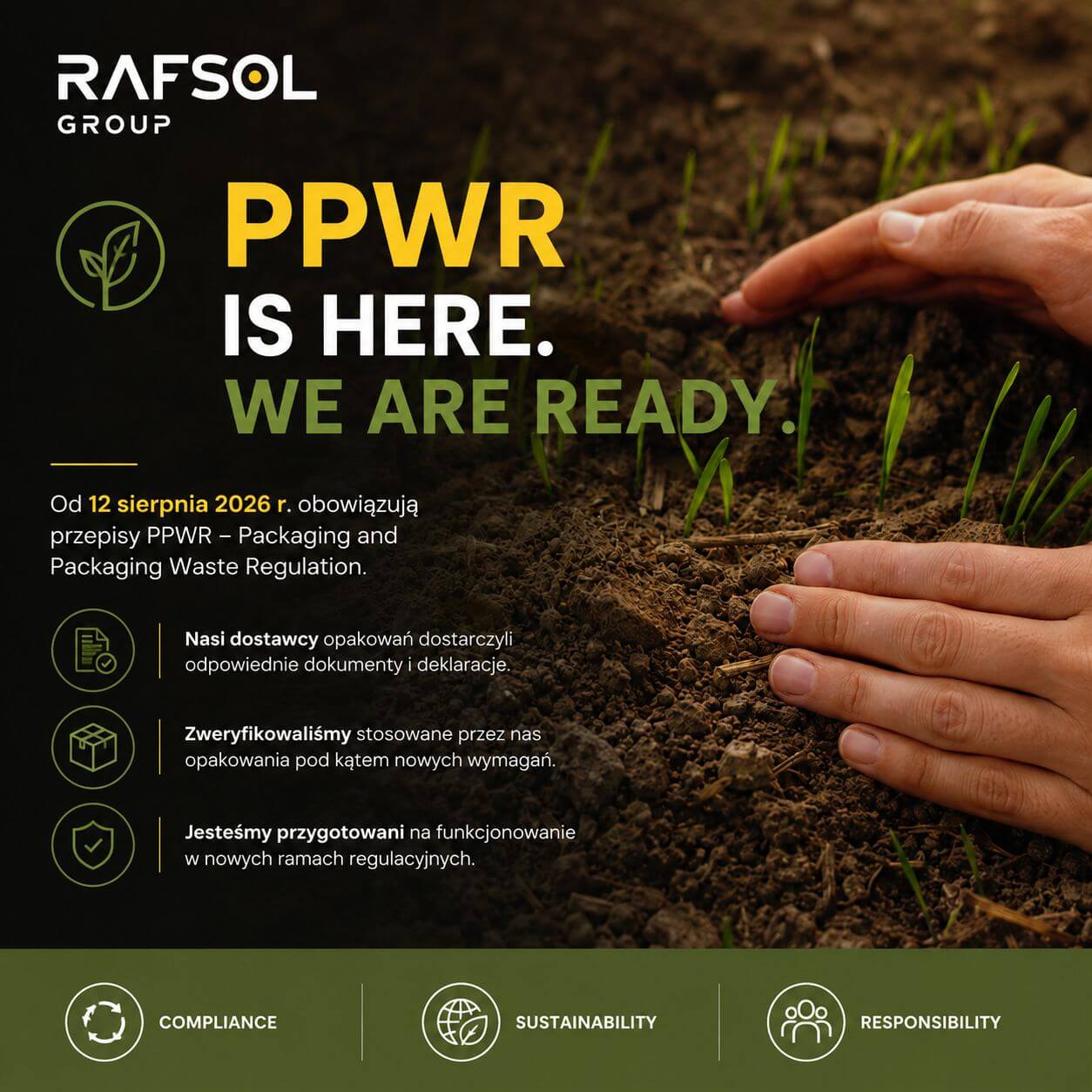
- We have reviewed the packaging we use for compliance with PPWR requirements and collected the relevant documentation and declarations from our suppliers.
PPWR – What Is It and Who Does It Apply To?
The PPWR is Regulation (EU) 2025/40 of the European Parliament and of the Council on packaging and packaging waste, which standardises the rules on packaging design, labelling and documentation across the Union. Changing the legal form from a directive to a regulation significantly increases the harmonisation of packaging requirements throughout the EU and reduces the risk of divergence arising from national transposition.
The range of economic operators covered by the Regulation is broad. The PPWR imposes obligations on individual participants in the supply chain – manufacturers, importers and distributors in particular – with the extent of responsibility depending on the role of the business in question. Particularly relevant is the situation in which a company commissions the design or manufacture of packaging, or of a packaged product, under its own name or trade mark: it may then be regarded as a manufacturer within the meaning of the PPWR.
The Regulation covers all categories: sales, grouped, transport and industrial packaging. In the practical context of vegetable fat supply, this means 3, 5 and 10 l bottles, buckets, cartons, bag-in-box, film and pallets, as well as the IBC containers used in bulk deliveries.
PPWR – When Does It Enter into Force and What Deadlines Apply?
The question “PPWR – when does it enter into force” calls for a distinction between two dates. The Regulation entered into force on 11 February 2025, while its general date of application is 12 August 2026. From that date, Directive 94/62/EC ceases to have effect and the material requirements are introduced in stages.
| Deadline | What starts to apply |
|---|---|
| 11 February 2025 | Entry into force of Regulation (EU) 2025/40 |
| 12 August 2026 | General date of application – obligations of manufacturers, importers and distributors, EU declaration of conformity and technical documentation, substance restrictions (sum of concentration levels of Pb, Cd, Hg and Cr(VI) ≤ 100 mg/kg, and PFAS limits in food contact packaging), repeal of Directive 94/62/EC |
| 2027–2028 | Commission delegated acts – including the criteria for recyclability performance grades A, B and C and the methods for calculating them |
| from 12 August 2028, or 24 months after the entry into force of the relevant implementing acts | Harmonised material labelling of packaging |
| from 2030 | Recyclability, minimum recycled content, packaging minimisation, reuse targets, bans on selected formats |
A phased timetable does not mean that preparations can be postponed. Design decisions taken today – the choice of bottle material, carton construction, type of film – will be assessed against criteria that come into effect several years from now.
PPWR Declaration of Conformity – The Document Your Customer Will Ask For
The PPWR declaration of conformity (DoC), together with the technical documentation, is becoming a key element in demonstrating packaging compliance and may increasingly be verified by customers during supplier qualification. It is drawn up by the manufacturer for each packaging type, and the template is set out in Annex VIII to the Regulation. The document confirms compliance with the requirements that already apply – including the restrictions on potentially hazardous substances.
For food technologists and purchasing departments in the food industry, one practical conclusion matters most: packaging documentation is becoming part of supplier qualification, alongside raw material specifications and management system certificates. A customer audit will increasingly include questions about the origin and status of the packaging in which the fat or oil is delivered.
—
Also read: Rapeseed oil wholesale – 3 l, 5 l and 10 l bottles, 1000 l IBC and tanker deliveries
—
Packaging and the PPWR at Rafsol Group – How We Have Prepared
We analysed the PPWR requirements for packaging well in advance, reviewing our entire packaging range. Our packaging suppliers provided the relevant documentation and declarations, and we verified that the solutions we use comply with the new requirements.
Our preparations covered:
- sales packaging – 3, 5 and 10 l bottles and 10, 20 and 22 l buckets,
- carton packaging and the bag-in-box line,
- grouped and transport packaging – outer cartons, film, pallets,
- 1000 l IBC containers used in bulk deliveries,
- documentation and declarations obtained from our packaging suppliers.
We treat packaging in the same way as quality systems in production – as an element of supplier credibility, not a formality. We apply the same standard to the certifications we maintain for vegetable fat production
FAQ – The PPWR Regulation in B2B Practice
Does the PPWR require implementation through Polish national legislation?
No. The PPWR is a regulation, not a directive, so it applies directly in all Member States. National provisions may only supplement it, for example in respect of penalties and the extended producer responsibility scheme.
Are transport packaging and pallets also subject to the PPWR?
Yes. The Regulation covers sales, grouped, transport and industrial packaging – regardless of the material and the place of manufacture. Film, outer cartons and pallets fall within the scope of the rules on the same basis as a bottle or a bucket.
Do tanker deliveries require packaging documentation?
As a rule, transporting a product in bulk in a tanker does not involve the use of sales or transport packaging within the meaning of the PPWR. The Regulation excludes road, rail, ship and aircraft containers from the definition of transport packaging. Packaging obligations therefore need to be assessed differently than for deliveries in IBCs, drums, buckets or other packaging formats. For plants with high raw material consumption, this is a further argument when choosing a delivery format.
What documentation can a customer request from a fat supplier?
In practice, these are declarations and documentation relating to the packaging used by the supplier, obtained from the manufacturers of that packaging. The scope is agreed individually as part of contract management.
When do the recycled content requirements start to apply?
The key material obligations – recyclability, minimum recycled content, packaging minimisation and reuse targets – start to apply on 1 January 2030, with further thresholds set for the following years.
If your plant is currently reviewing its supply chain in the light of the PPWR, we will be glad to discuss the packaging formats available and the scope of documentation we are able to provide. Submit an enquiry – we will respond with a specific proposal for your volume and specification.